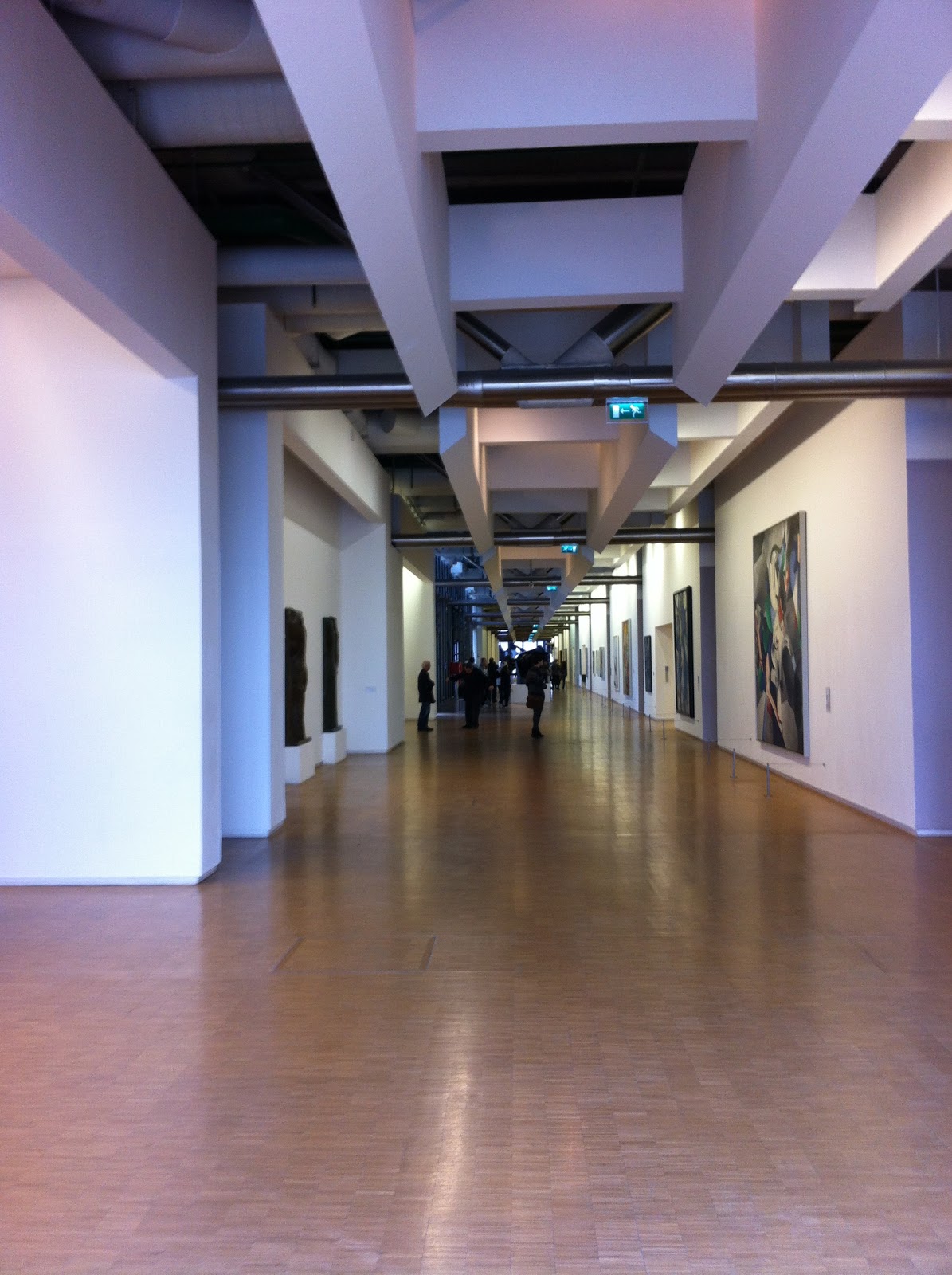
Having been rather unlucky/disorganised with gallery opening times I was feeling rather pressured to cram on our last day. With slight deja vu we jumped on the bus to the
Centre Pompidou which is not only the largest museum of modern art in Europe but also houses a vast public library and IRCAM, a centre for music and acoustic research. It was to be a nerve centre of French art and culture, uniting different forms of expression under one roof. Designed by Italian architects Renzo Piano, Gianfranco Franchini and British architect Richard Rogers in the style of high-tech architecture, 1971-1977, and named after the French President at the time George Pompidou.
The resulting look was no doubt 'high-tech' in appearance, it was like nothing I had ever seen before. The building appeared to have been turned inside out showing an exposed skeleton of metal work and brightly coloured tubes that resembled hamster tunnels making it look more like a machine than a building.
 |
| Centre Pompidou from the front |
 |
| Centre Pompidou from the back |
This guy was also painted on a building round the corner who I thought was quite cool...
Once we were inside, rather pleased with ourselves for sneaking in free by telling a wee white lie that we were a year younger and playing the dumb foreign card we headed up, through the maze of hamster tunnels, to level fives permanent collection. This floor charted modern arts development from 1905 to the 1960's. Painting, sculpture, drawing, photography, cinema, design and architecture filled the huge gallery space. The works on show illustrated the main movements at the beginning of the 20th century - Cubism, the birth of abstraction, Dada, early Surrealism - along with monographs. The post-1945 period saw the emergence of new movements: the new French realists and American Neo-Dadaists, kinetic art, design and architecture.
There were so many fantastic works I got a bit carried away taking photos.
 |
| Ten Lizes, 1963 - Andy Warhol |
 |
| Electrical Prisms, 1914 - Robert Delaunay |
 |
| Picasso |
 |
| 'La Jambe,' 1958 - Giacometti |
Back down the hamster tunnel led to the other half of the permanent collection, 'Contemporary Art from 1960 to the Present,' renewed every two years to keep it 'contemporary.' It offered a chronological journey with recent acquisitions given pride of place. The exhibition began with work by several well know artists, moving onto lesser known ones. Lastly architecture, design, photography new media and cinema were presented. By definition modern art is always in motion - new artists emerge and trends surface, it is the museums aim is to bring these things to the public eye so as to write a history of the last fifty years of art in the present tense.
Before catching our eurostar at 7 I didn't really feel we could come to Paris without popping into the
Musee d'Orsay, even if it was a flying visit. Arriving to rather a large queue we really didn't have much time at all so had to be selective, choosing to spend most of our time in the 'Gallerie Des Impressionnistes.'
 |
| Inside the Musee d'Orsay from the 5th floor |
The Musee is housed in the former Gare d'Orsay, an impressive beaux-arts railway station, 1898-1900. It holds predominantly French art dating from 1848-1915, including paintings, sculptures, furniture and photography. Most famous for holding the worlds largest collection of Impressionist and Post-Impressionist works by artists such as Monet, Manet, Degas, Renoir, Cezanne, Gauguin, Van Gogh, Sisley plus many more.
On the ground floor was the 'Galerie Symboliste' which had some fantastic pieces by Toulouse-Lautrec, one of my all time favourites.
 |
| The Dance at the Moulin Rouge, 1895 - Toulouse-Lautrec |
 |
| Femme de Profil (Madame Lucy) |
Up a level was the 'Galerie Neo et Post-Impressionniste' holding a few more favourites by Van Gogh, as well as a sculpture gallery with the plaster original of Rodin's Gates of Hell, 1888-1917.
 |
| Self-Portrait, 1889 - Van Gogh |
 |
| L'eglise d'Auvers-sur-Oise, vue de chevet, 1890 |
 |
| La nuit etoilee, 1888 |
 |
| The Gates of Hell, 1888-1917 - Rodin |
On the 5th floor was the 'Galerie des Impressionnistes,' the collection traces the history of the movement from its origins in the 1860's, to its continuing influence into the 20th century. In 1873 Monet, Renoir, Degas, Cezanne, Sisley, Pissarro and Berthe Morisot organised an exhibition outside the official Salon. The first exhibition in 1874 was met with shock as their works were considered unfinished sketches, using the term 'Impressionist' for the first time.
 |
| Nympheas Bleus, 1916-1919 - Monet |
Although they didn't follow a coherent programme they depicted changes in the modern world, concentrating in the 1870's on the stations, dances and cafes of Paris, as well as its suburbs - a place for both leisure and industry. They prefered a style of painting that captured moment, that conveyed a personal and subjective impression of the changing world. The brushwork is rapid and visible; the framing is often off centre; the colours are light, seeking to capture the atmospheric effects outdoors in contract to the precise, highly polished paintings produced in the studio that were exhibited at the Salon.
 |
| Dance Class at the Opera, 1874 - Degas |
By 1886 eight collective exhibitions had been organised, in spite of increasing divergences between artists who, from the 1890's on, were moving in new and personal directions. After several difficult years, when the Impressionists were particularly reliant on the support of a small group of committed art lovers, dealers and critics, the beginning of the 20th century saw these painters, who had overturned traditional methods of representation, achieve success and international recognition.
 |
| Mont Sainte-Victoire, 1890 - Cezanne |
There were so many iconic works on display I could have spent all day there. Sadly time did not allow - oh well I will just have to visit again.